Monday, September 3, 2018

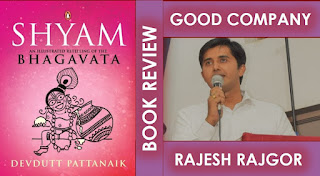
Rajesh Rajgor's Book Review of Shyam: An Illustrated Retelling Of the Bhagavata

Who doesn’t know the popular Hindu deity Lord Krishna? He is the 8th Avatar of Lord Vishnu aka the creator of the universe, the source of all that exists! Krishna is adored in many different forms, for some he is who steals butter (makkhan chor) who started the formation of human pyramid to break the now famous dahi-handi, he is known for his Raas Leela with Radha and Gopis, He who is the Charioteer of Arjun in Mahabharta, and the narrator of Bhagavat Geeta. So, what is it that Author Devdutt Pattanaik wants to decode with his new book Shaym an Illustrated retelling of Bhagavata…. Let’s find out…
The book makes a strong case for ‘Jo Hota Hai Ache Ke Liye Hota Hai’ Every action, good or bad, has an equal and opposite reaction. Even though Krishna sided the Pandavas, to establish dharma that the mighty should protect the weak, poor and meek, he faced Gandhari’s (mother of Kauravas) anger, who felt Krishna could have averted the war!

Pattanaik’s book is a treasure of many such anecdotes. It is by far a thoroughly researched work about Krishna. It puts forth several references, insights and trivia in the grey boxes below the main story that invokes your imagination about the broader mythology associated with the main story. Kuch references Harivamsa se hain (that speaks of his pastoral foster family), toh Kuch Vishnu Purana (that refers to him as Vishnu’s avatar), There are a few mentions of Shrimad Bhagavata Purana and the Geet Govind of Jayadeva (that introduces us elaborately to Radha). Parallels from Greek mythology and references from Jain mythology builds up a good back story for the main story. Also, how Krishna is a purna purush (Perfect Man) and that he sees good in everything is well narrated in incidents of him accepting female attire as a punishment and also in an exchange of clothes with Radha! Something that challenges the many fake masculinity images of contemporary Indian men. There are various points at which Pattnaik also makes a note of how ancient India had no inhibitions in accepting a dark skin hero, which is so unlike the modern-day obsession about fairer complexions.

However, despite its various highs, I was disappointed in the area where Krishna as a narrator recites the Bhagavat Geeta to Arjuna. Having picked up the book thinking the it could also simplify the different chapters of the Bhagavat Geeta, the book fails to rise beyond the central message of Geeta- that is your Karma is more important than your emotional connect. Similarly, a few of you, who have grown up watching Shri Krishna on television or read about it in other books, may find the chapters dealing with his pranks during his infant to cowherd known. Also, until you warm up to the recurring boxes that puts various mythologies in perspective, you may find the break of flow from the main story a bit confusing and overwhelming to hold on to. Reference to various new names and their relationships to Krishna is hard to keep up with. But we can hardly, blame the writer for that. In fact, he has to be applauded for collating it all together in one book.

In a nutshell, the book will help you understand Krishna, before his birth, his life on earth and his life after death. It will help you accept things as they are and find good behind every thing happening to you. The true purpose is achieved when the writer succeeds in giving each one of us a distinct ‘meaning’ within the infinite possibilities that life offers us. As the writer himself describes, ‘Within Infinite myth is an eternal truth, who sees it all? Varuna has but a thousand eyes, Indra a hundred, you and I only two.’

Saturday, October 29, 2016

Matters of heart can be solved with logic!

In a recent interview to Film Companion, Karan Johar said, "There is logic in ADHM. The lead hero aspires to be a singer and therefore sings." I think the logic ends precisely there. What about love and relationship Karan?

For many, like me, who have grown on film's by Johar and Yash-Adi Chopra, love either results in couple's unision (Dil Toh Pagal Hai, Kuch Kuch Hota Hai) or sacrifice and move on! (Kabhi Alvida Naa Kehna, Kal Ho Naa Ho)

ADHM lingers between one sided love (without apt justification why Anushka's character Alizeh doesn't reciprocate love to the 'Aashiq' Ranbir's- Ayan till the end) and Friendship which actually is so blown out of proportion that it doesn't appear to be Friendship but love. (Remember ek Ladka aur ek Ladki kabhi dost nahi ho saktey if one of them is so close-physically chipku -Hum Tum)

Once Ayan confesses love and is rejected, he moves on - partially to somebody who is shown to understand love but is a divorcee! Alizeh suffocates in her other 'lovely' relationship and disappears without giving hint to even his lover Ranbir, it is Ranbir's one sided love that fumes on her news of absconding, ditto Jab We Met style, to find her, only to re-discover that she still feels Ranbir to be a friend (Matlab- Kuch Kuch Hota Hai Par Tum Nahi Samjhogey)

ADHM is a film of contradictions. Alizeh who keeps on saying "Mohabbat karna humarey bas mein nahi, ussey dur jaana humarey bas main hain" Then why did she go back to the first lover when he has ditched her! Ranbir once says 'Aasan Hai Kya, Aisi Mohabbat Karna Jiskey Badley Mohabbat Na Miley? It is not! Then why hope for reciprocation throughout the film and crib about it! (Btw he does same to Ash-No strings attached, "Rishta wo jo aasani se toot jaaye.") No body taught them to Move on with memories in heart!

Imagine, if in Kuch Kuch Hota Hai, while the daughter reunites SRK with Kajol and SRK says 'I am just your friend' or in Kal Ho NA Ho, Preity refuses to marry Saif after SRK has sacrificed his love or in Jab We Met, Kareena would not have accepted Shahid after he rediscovers her-would the films have been successful and loved by masses.

ADHM tries hard to feed us that 'matters of heart are difficult' through forced emotional complications. It can be easily resolved with logic. Move on guys!

Post-script: Ranbir Kapoor, can't keep selecting scripts where he is subjected to confusion, careless and childish behaviour. Time is already up for him. Better actors with wider range like Ranveer Singh, Sushant Singh and Varun Dhawan are catching up. Confused, Childish and careless persona cannot be labelled and sold as versatile acting.

Anushka is natural but her character suffers between selfishness and self awareness. Aishwarya's exit is difficult to digest and I wish Ranbir and she would have settled for each other. However, the director is adamant on making us feel the resilience of heart's "ek tarfa pyaar"- alas through vulnerability of logic and from the mouth of an accomplished 'lover boy' who has 'acquired' other's love in every romantic film he did.

2/5 stars.

Thursday, May 5, 2016

Should I do Bachelors of Mass Media (BMM)? How good are the career prospects?

A lot of students have been calling me off late. Most of them who have given the HSC (12th grade) examination call to seek advice on whether or not to take BMM. Let me put at the on set, I am not a big expert, but having done BMM myself (graduated in 2007) I posses a decent understanding about how the next 3 years for a student opting to do BMM would be and what there career prospects could be.

A student of BMM will have to go through 36 different subjects over the 3 years ranging from, Economics, Political Science, Creative Writing, Broadcast Journalism, Niche Magazine Journalism, Photography, Introduction to PR, Media Studies, Culture Studies, Understanding Cinema etc..

It is in the last year of the course that one has to select a specialisation - Advertising or Journalism. However the dilemma for many who call me (especially from Commerce) is whether the professional course has an immediate job prospect? I answer by saying YES. Many still have doubts. Will they have to struggle and slog a lot to reach the desired post? Guess what YES.

Guaranteed employment a myth?
It is not the case with only BMM or BMS or even BAF etc. It is with every field. Tell me one field which confirms employment? Students will have to start from junior roles and learn the tricks of the trade by being in an area of interest. Where money is riding high, not every individual gets prime responsibility immediately. There are jobs available both in print and electronic media, one has to get in spend years and then apply what they have learned at the courses. I did it it the same way. Learned the hard way. I know my friends who took jobs as PR, copy writers, creative associates, short-film-makers, assistant directors, content writers, digital strategists, communication managers, copy-editors, proof-readers etc. Everything that is taught at the course in 3 years is a window to the big professional set-up. You will have to be a jack of all trades and (unlike the complete proverb) eventually you will end up becoming a master of something. What is important is each step you take and the experiences you gain from it.

Remember, while you are learning these subjects in an academic set-up, add value to your over-all personality by learning, graphic designing, movie-editing, nuances of English language, MS Office, a bit of accounting and commerce. All these soft-skills will somewhere help you in securing a much lucrative job. You never know you may start your own editing or graphic designing studio. So get ready to explore while you take a deep plunge into the world of Mass Media.

Friday, January 1, 2016

A Little Bit of Slope Makes Up for a Lot of Y-Intercept

From a lecture by Professor John Ousterhout.
Here's today's thought for the weekend.  A little bit of slope makes up for a lot of Y-intercept.

[Laughter]
So at a mathematical level this is an obvious truism.  You know if you have two lines, the red line and the blue line and the red line has a lower Y-intercept but a greater slope then eventually the red line will cross the blue line.

And if the Y-axis is something good, depending on your definition of something good, then I think most people would pick the red trajectory over the blue trajectory (..unless you think you're going to die before you get to the crossing point).

[Laughter]

So in a mathematical sense it's kind of obvious.  But I didn't really mean in a mathematical sense, I think this is a pretty good guideline for life also.  What I mean is that how fast you learn is a lot more important than how much you know to begin with.  So in general I say that people emphasize too much how much they know and not how fast they're learning.

That's good news for all of you people because you're in Stanford and that means you learn really, really fast.  This is a great advantage for you.  Now let me give you some examples.  The first example is: you shouldn't be afraid to try new things even if you're completely clueless about the area you're going into.  No need to be afraid about that.  As long as you learn fast you'll catch up and you'll be fine.

For example I often hear conversations the first week of class where somebody will be bemoaning, "Oh so-and-so knows blah-blah-blah, how am I ever going to catch up to them?"  Well, if you're one of the people who knows blah-blah-blah it's bad news for you because honestly everyone is going to catch up really quickly.  Before you know it that advantage is going to be gone and if you aren't learning too you're going to be behind.
Another example is that a lot of people get stuck in ruts in their lives.  They realize they're in the wrong job for them.  I have the wrong job or the wrong spouse or whatever…

[Laughter]

And they're afraid to go off and try something new.  Often they're worried, I'm going to really look bad if I go..

[Laughter]

I'm kidding about the spouse.  But, seriously people will be afraid to try some new thing because they're worried they'll look bad or will make a lot of rookie mistakes.  But, I say, just go do it and focus on learning.

[Laughter]

Let me take the spouse out of the equation for now.

[Laughter]

Focus on the job.
Another example is hiring.  Before I came back to academia a couple of years ago I was out doing startups.  What I noticed is that when people hire they are almost always hire based on experience.  They're looking for somebody's resume trying to find the person who has already done the job they want them to do three times over.  That's basically hiring based on Y-intercept.

Personally I don't think that's a very good way to hire.  The people who are doing the same thing over and over again often get burnt out and typically the reason they're doing the same thing over and over again is they've maxed out.  They can't do anything more than that.  And, in fact, typically what happens when you level off is you level off slightly above your level of competence.  So in fact you're not actually doing the current job all that well.

So what I would always hire on is based on aptitude, not on experience.  You know, is this person ready to do the job?  They may never have done it before and have no experience in this area, but are they a smart person who can figure things out?  Are they a quick learner?  And I've found that's a much better way to get really effective people.

So I think this is a really interesting concept you can apply in a lot of different ways.  And the key thing here I think is that slow and steady is great.  You don't have to do anything heroic.  You know the difference in slopes doesn't have to be that great if you just every day think about learning a little bit more and getting a little bit better, lots of small steps, its amazing how quickly you can catch up and become a real expert in the field.

I often ask myself: have I learned one new thing today?  Now you guys are younger and, you know, your slope is a little bit higher than mine and so you can learn 2 or 3 or 4 new things a day.  But if you just think about your slope and don't worry about where you start out you'll end up some place nice.

Ok, that's my weekend thought.
[Applause]

Wednesday, October 28, 2015

Why Creativity Shouldn’t Be Cheap: Written by Yvette Tan

A few days ago, I came across this post on Facebook:

I don’t know where it’s from so I can’t cite sources, but it generated a lot of response when I reposted it. It’s a constant headache among people in the creative industry–graphic artists, writers (especially writers!), photographers, and so on–that they are under-compensated, their work undervalued.
There are two prevailing notions behind this that I know of:
First, non-creatives have the tendency to think that just because anyone can, say, a. write, b. buy a DSLR, and c. take a graphic design class, these are automatically skills that everyone can possess.  Professional writers suffer from this misconception the most because in theory, even a first grader can string a sentence together and if a seven year-old can write, then it shouldn’t be a hard skill to master, right?
Wrong.
The second misconception is that creatives work like machines in the manufacturing industry, in the sense that the more work you make them do, the cheaper production gets. Many people think that projects that involve creativity can be bought wholesale, again, like physical products.
Wrong again.
Let me tackle the second point first. Unlike machines, which have moulds and run on continuous power, ensuring (theoretically) quality product all the time, creatives are human beings that use brain power. Contrary to popular belief, thinking is hard work, even if it does not burn much calories. It tires the body and fatigues the mind. Quality of work can diminish without rest. Whether you want to give someone a discount because s/he has given you a lot of work is up to you, but they shouldn’t be able to use ‘buying wholesale’ as an excuse.
Now the first point. Yes, a seven year-old can fill a notebook with words. And yes, that same seven-year old can take nice photos (but hopefully not with a DSLR, unless you are very, very wealthy). But what people don’t realise is that what they’re buying isn’t just someone who will do a job that they could do themselves, if only they had the time. What they are buying, particularly when they hire a professional, is the time, effort, and experience that person put into honing his or her craft.
What you are buying are words that every client, every investor, loyal or potential, will see, so it is in your best interest to make sure that those words are damn good.
Obviously, this post comes from a personal disappointment. As a young writer, I kept coming across these two arguments, and I didn’t know how to respond to them. I don’t know where I read it, but now I know how to explain why we charge what we charge:
What we charge isn’t really high because when you divide the amount spent on art/ copy by the number of people you want to impress (clients, investors, employees, your mother) and the profit/ morale you will generate from it, then you will realise that what you are paying isn’t expensive at all.
If you ask me, most creatives still aren’t being paid enough for their work. I’m still hoping that this changes someday.

Posted on : http://yvettetan.com/2012/11/26/why-creativity-shouldnt-be-cheap/

Friday, August 14, 2015

Gour Hari Dastaan impresses parliamentarians

It takes patience and perseverance of unimaginable levels to come even somewhat close to what Gour Hari Das has accomplished. For the uninitiated, he fought a silent war for 32 long years against his own government to prove his patriotic association towards the nation. Finally, after three full decades, the government gave him a certificate recognising his work as a freedom fighter.

As you might be aware, Ananth Mahadevan's film GOUR HARI DASTAAN, inspired by his life is all set to release this Friday. Ask the freedom fighter how important is the film for him and he immediately says, "It's not important for me, it's important for the next generation. I hope whatever I have done is a source of inspiration for the new generation to do something for others and for society." 

He goes on to add, "The difference between the youth of today and pre-independence is that in those days when we planned to sabotage or attack the British, our cause was justified because we were fighting for the country. Today the youth lack aim and motive. They merely blow up trains, kill innocent people and fall prey to misleading religious fanaticism. Everything is wrongly politicised. The youth of today need to learn from the youth of our time."

According to Das, Vinay has done a superlative job in the film. "Vinay is fantastic in the film. How good he is can't be expressed in words. I have quite a few clippings and photos of him from the film. Looking at them, I sometimes can't believe that he's not me. He put in a lot of efforts to look similar to me," says Das on a concluding note.

Impresses parliamentarians

A full house of members of parliament including ex commissioner of police Satyapal Singh and other prominent names loudly applauded and hailed GOUR
HARI DASTAAN-THE FREEDOM FILE in Delhi. Das was mobbed and feted by them and they even decided to discuss the film in parliament and the issues it
raised. Praises from "genial" to "the most important film of our time" were showered on the film. 

Despite parliament in session, the MPs made it a point to attend the screening and watched spellbound reacting at all the right places where the acidic humour made them laugh. The dialogue and Vinay Pathak's spellbinding performance came in for special praise.

GOUR HARI DASTAAN also stars Konkona Sen Sharma, Ranvir Shorey and Tannishtha Chatterjee in pivotal roles.